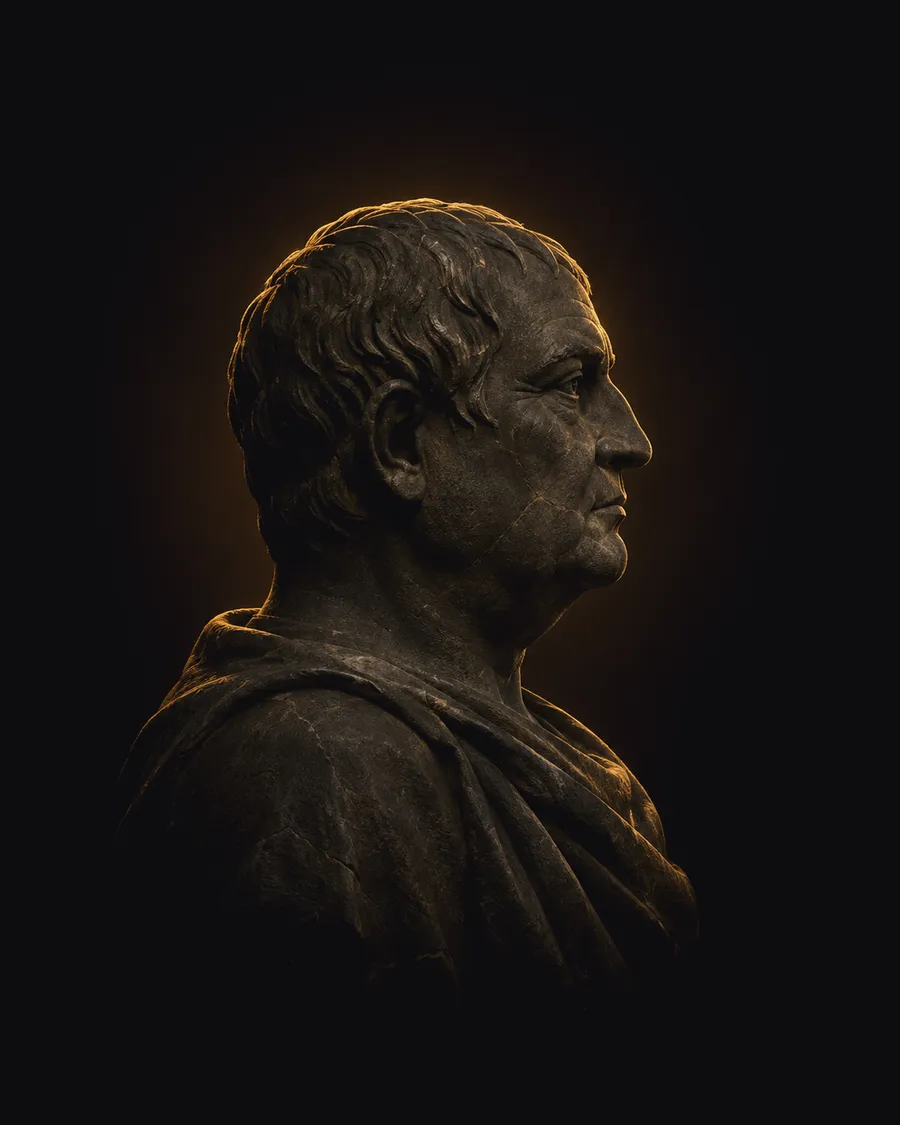
“There are more things, Lucilius, likely to frighten us than there are to crush us; we suffer more often in imagination than in reality.”
Seneca, Letters 13.4
More things scare us than harm us. We suffer more often in our heads than in fact.

70 lines from the letters Seneca wrote to his friend Lucilius, sorted by theme. Under each one you see which letter it comes from and what it means today.
In the Stoic Quotes app. 3 days free on the annual plan.
Every quote here comes from Seneca’s letters to Lucilius, in Richard Gummere’s translation, and was checked word for word against the text. His essays, such as On Anger, and his plays are left out.
Letter 13 is about fear. He compares us to soldiers who abandon their camp because stampeding cattle raised some dust.
“There are more things, Lucilius, likely to frighten us than there are to crush us; we suffer more often in imagination than in reality.”
Seneca, Letters 13.4
More things scare us than harm us. We suffer more often in our heads than in fact.
“… some things torment us more than they ought; some torment us before they ought; and some torment us when they ought not to torment us at all. We are in the habit of exaggerating, or imagining, or anticipating, sorrow.”
Seneca, Letters 13.5
We make pain bigger than it is, feel it too early, or feel it over something that is no trouble at all.
“How often has the unexpected happened! How often has the expected never come to pass! And even though it is ordained to be, what does it avail to run out to meet your suffering?”
Seneca, Letters 13.10
Plenty of things you expected never came. If this one does come, running to meet it gains you nothing.
“It is indeed foolish to be unhappy now because you may be unhappy at some future time.”
Seneca, Letters 24.1
A bad day that may come is a poor reason to ruin this one.
“He suffers more than is necessary, who suffers before it is necessary …”
Seneca, Letters 98.8
Worry adds suffering you did not have to have.
“Beasts avoid the dangers which they see, and when they have escaped them are free from care; but we men torment ourselves over that which is to come as well as over that which is past.”
Seneca, Letters 5.9
An animal runs from danger and then calms down. We go on suffering over the past and the future.
“Remember, however, before all else, to strip things of all that disturbs and confuses, and to see what each is at bottom; you will then comprehend that they contain nothing fearful except the actual fear.”
Seneca, Letters 24.12
Take away the noise and look at the thing itself. What is left to fear is the fear.
“A man is as wretched as he has convinced himself that he is.”
Seneca, Letters 78.14
How miserable you are depends on how miserable you tell yourself you are.
“For the soul is more powerful than any sort of Fortune; by its own agency it guides its affairs in either direction, and of its own power it can produce a happy life, or a wretched one.”
Seneca, Letters 98.2
Luck hands you the material. Whether it turns into a happy life or a wretched one is up to your own mind.
“And we cannot change this order of things; but what we can do is to acquire stout hearts, worthy of good men, thereby courageously enduring chance and placing ourselves in harmony with Nature.”
Seneca, Letters 107.7
Cold, heat and loss will come whatever we do. What we can build is the courage to bear them.
“If you would escape your troubles, you need not another place but another personality.”
Seneca, Letters 104.8
A new city will not help if the same you moves in.
“While we are postponing, life speeds by.”
The first letter opens with it. He admits that he wastes time too, but he can at least say what he is wasting.
“Nothing, Lucilius, is ours, except time. We were entrusted by nature with the ownership of this single thing, so fleeting and slippery that anyone who will can oust us from possession.”
Seneca, Letters 1.3
Time is the only thing we own, and almost anybody can take it from us.
“… hold every hour in your grasp. Lay hold of to-day’s task, and you will not need to depend so much upon to-morrow’s.”
Seneca, Letters 1.2
Keep hold of your hours. The more you do today, the less you need from tomorrow.
“… the largest portion of our life passes while we are doing ill, a goodly share while we are doing nothing, and the whole while we are doing that which is not to the purpose.”
Seneca, Letters 1.1
Much of life goes into mistakes, some of it into nothing, and all of it into things that miss the point.
“One who daily puts the finishing touches to his life is never in want of time.”
Seneca, Letters 101.8
If you finish your life off each day, you are never short of time.
“No man is at the mercy of affairs. He gets entangled in them of his own accord, and then flatters himself that being busy is a proof of happiness.”
Seneca, Letters 106.1
Nobody forces the busy life on you. You walk into it, then take being busy as a sign that you are happy.
“… life is so short; and we make it still shorter by our unsteadiness, by making ever fresh beginnings at life, now one and immediately another. We break up life into little bits, and fritter it away.”
Seneca, Letters 32.2
Life is short, and starting over again and again makes it shorter. We crumble it and let the crumbs go.
Letter 71 is about having an aim. Letter 77 compares life to a play, where the acting counts and the length does not.
“It is with life as it is with a play,—it matters not how long the action is spun out, but how good the acting is.”
Seneca, Letters 77.20
As with a play, the length matters little. What counts is how well it is acted.
“Our plans miscarry because they have no aim. When a man does not know what harbour he is making for, no wind is the right wind.”
Seneca, Letters 71.3
Plans fail when they have no goal. If you do not know where you are sailing, no wind can help you.
“The reason we make mistakes is because we all consider the parts of life, but never life as a whole.”
Seneca, Letters 71.2
We go wrong because we think about pieces of life and never about all of it.
“There are only a few who control themselves and their affairs by a guiding purpose; the rest do not proceed; they are merely swept along, like objects afloat in a river.”
Seneca, Letters 23.8
A few people steer by a purpose. The rest float where the river takes them.
“Pray, let us see to it, my dear Lucilius, that our lives, like jewels of great price, be noteworthy not because of their width but because of their weight.”
Seneca, Letters 93.4
Judge a life the way you judge a jewel, by its weight. Size comes second.
“Life is not a dainty business. You have started on a long journey; you are bound to slip, collide, fall, become weary …”
Seneca, Letters 107.2
Life is a rough trip. You will stumble, bump into things and get tired.
“Believe me, it is a great rôle—to play the rôle of one man.”
Seneca, Letters 120.22
Being the same person all the way through is a great part to play.
“For sometimes it is an act of bravery even to live.”
Seneca, Letters 78.2
There are times when simply going on takes courage.
He wrote a whole work On Anger. In the letters the topic comes up in passing, once while his cook and baker are late with dinner (123.1).
“And it makes no difference how important the provocation may be, but into what kind of soul it penetrates. Similarly with fire; it does not matter how great is the flame, but what it falls upon.”
Seneca, Letters 18.15
The size of the insult matters less than the mind it lands in. A spark needs something dry.
“… the outcome of a mighty anger is madness, and hence anger should be avoided, not merely that we may escape excess, but that we may have a healthy mind.”
Seneca, Letters 18.15
Great anger ends in madness. Avoid it for the sake of a sound mind.
“… nothing is heavy if one accepts it with a light heart, and that nothing need provoke one’s anger if one does not add to one’s pile of troubles by getting angry.”
Seneca, Letters 123.1
Taken lightly, nothing weighs much. Getting angry only adds one more trouble to the pile.
“That which annoys us does not necessarily injure us; but we are driven into wild rage by our luxurious lives, so that whatever does not answer our whims arouses our anger.”
Seneca, Letters 47.19
What annoys us may do us no harm. Comfort has spoiled us, so anything that does not go our way makes us furious.
“Every emotion at the start is weak. Afterwards, it rouses itself and gains strength by progress; it is more easy to forestall it than to forgo it.”
Seneca, Letters 116.3
A feeling starts small and grows as it runs. Stopping it early is easier than dropping it later.
“He will not misinterpret a word or a look; he makes light of all mishaps by interpreting them in a generous way. He does not remember an injury rather than a service.”
Seneca, Letters 81.25
This is how a wise person takes other people: reads nothing bad into a look, finds the kind explanation, and remembers the favor before the wrong.
“Treat your inferiors as you would be treated by your betters.”
Seneca, Letters 47.11
Behave toward people below you the way you want the people above you to behave toward you.
Letter 18 sets homework: a few days of cheap food and rough clothes.
“Above all, my dear Lucilius, make this your business: learn how to feel joy.”
Seneca, Letters 23.3
Joy is something you learn. Make that your job.
“We have reached the heights if we know what it is that we find joy in and if we have not placed our happiness in the control of externals.”
Seneca, Letters 23.2
You have arrived when you know what gives you joy and nothing outside you decides whether you get it.
“… they regard the means for producing happiness as happiness itself, and, while seeking happiness, they are really fleeing from it.”
Seneca, Letters 44.7
People mistake the tools of happiness for happiness, so chasing it takes them away from it.
“To have whatsoever he wishes is in no man’s power; it is in his power not to wish for what he has not, but cheerfully to employ what comes to him.”
Seneca, Letters 123.3
You cannot have everything you want. You can stop wanting what is missing and gladly use what you get.
“When you see many ahead of you, think how many are behind!”
Seneca, Letters 15.10
When you count the people ahead of you, count the ones behind you too.
“It is not the man who has too little, but the man who craves more, that is poor.”
Seneca, Letters 2.6
Poor is whoever keeps wanting more, however much they have.
“Do you ask what is the proper limit to wealth? It is, first, to have what is necessary, and, second, to have what is enough.”
Seneca, Letters 2.6
How much money is right? What you need, and after that, enough.
“Money never made a man rich; on the contrary, it always smites men with a greater craving for itself.”
Seneca, Letters 119.9
Money has never made anyone rich. It makes people want more money.
“Nature’s wants are slight; the demands of opinion are boundless.”
Seneca, Letters 16.8
What you need is little. What you think you need has no end.
“Set aside a certain number of days, during which you shall be content with the scantiest and cheapest fare, with coarse and rough dress, saying to yourself the while: ‘Is this the condition that I feared?’”
Seneca, Letters 18.5
For a few days, eat the cheapest food and wear rough clothes, and ask yourself if this is what you were afraid of.
“Therefore, my dear Lucilius, begin at once to live, and count each separate day as a separate life.”
Letter 3 asks you to judge first and trust afterward. Letter 63 comforts Lucilius, whose friend has died.
“Ponder for a long time whether you shall admit a given person to your friendship; but when you have decided to admit him, welcome him with all your heart and soul.”
Seneca, Letters 3.2
Take your time choosing a friend. Once you have chosen, hold nothing back.
“It is equally faulty to trust everyone and to trust no one.”
Seneca, Letters 3.4
Trusting everybody is a mistake, and so is trusting nobody.
“No good thing is pleasant to possess, without friends to share it.”
Seneca, Letters 6.4
Good things give no pleasure without friends to share them with.
“Associate with those who will make a better man of you. Welcome those whom you yourself can improve. The process is mutual; for men learn while they teach.”
Seneca, Letters 7.8
Spend time with people who make you better, and welcome those you can help. Teaching is also a way of learning.
“He who begins to be your friend because it pays will also cease because it pays.”
Seneca, Letters 9.9
A friend who came for the benefit will leave for a benefit.
“… you must live for your neighbour, if you would live for yourself.”
Seneca, Letters 48.2
If you want a life for yourself, live for other people too.
“A friend should be retained in the spirit; such a friend can never be absent.”
Seneca, Letters 55.11
Keep your friend in mind and distance cannot take them away.
“Let us greedily enjoy our friends, because we do not know how long this privilege will be ours.”
Seneca, Letters 63.8
Enjoy your friends while you have them. Nobody knows for how long that is.
“Our relations with one another are like a stone arch, which would collapse if the stones did not mutually support each other …”
Seneca, Letters 95.53
People hold each other up like the stones of an arch. Without that, it falls.
As an old man he went to a philosopher’s lectures. Letter 76 answers the obvious remark about his age.
“… it is more important for you to keep the resolutions you have already made than to go on and make noble ones.”
Seneca, Letters 16.1
Keep the promises you already made to yourself before you make finer ones.
“Hold fast to it and establish it firmly, in order that what is now impulse may become a habit of the mind.”
Seneca, Letters 16.6
Hold on to that first push until it turns into a habit.
“There remains much more of the road than we have put behind us; but the greater part of progress is the desire to progress.”
Seneca, Letters 71.36
There is more road ahead than behind. Wanting to move is already most of the way.
“Our lack of confidence is not the result of difficulty; the difficulty comes from our lack of confidence.”
Seneca, Letters 104.26
Things look hard because we do not trust ourselves to do them.
“The reason is unwillingness, the excuse, inability.”
Seneca, Letters 116.8
We say we cannot. The truth is that we do not want to.
“The mind must, therefore, be forced to make a beginning; from then on, the medicine is not bitter …”
Seneca, Letters 50.9
You have to force yourself to start. After that it stops tasting bad.
“I shall keep watching myself continually, and—a most useful habit—shall review each day.”
Seneca, Letters 83.2
I keep an eye on myself and go over each day. It is a useful habit.
“‘How much progress shall I make?’ you ask. Just as much as you try to make.”
Seneca, Letters 76.5
You will get as far as you try to get.
“If you would not have a man flinch when the crisis comes, train him before it comes.”
Seneca, Letters 18.6
Nerves for a crisis are trained before the crisis.
Letter 12 tells of Pacuvius, who held his own funeral every day, with wine. Seneca keeps the idea and drops the party.
“You do not know where death awaits you; so be ready for it everywhere.”
Seneca, Letters 26.7
Death may be waiting anywhere, so be ready anywhere.
“It is not the last drop that empties the water-clock, but all that which previously has flowed out …”
Seneca, Letters 24.20
The clock empties with every drop, and we have been dying since the first one.
“… every day ought to be regulated as if it closed the series, as if it rounded out and completed our existence.”
Seneca, Letters 12.8
Run each day as if it were the one that completes your life.
“When a man has said: ‘I have lived!’, every morning he arises he receives a bonus.”
Seneca, Letters 12.9
Once you can say that you have lived, every new morning is extra.
“I am endeavouring to live every day as if it were a complete life.”
Seneca, Letters 61.1
I try to make every day a whole life.
“Death arrives; it would be a thing to dread, if it could remain with you. But death must either not come at all, or else must come and pass away.”
Seneca, Letters 4.3
Death would be frightening if it stayed. It is either not here yet or already over.
“Most men ebb and flow in wretchedness between the fear of death and the hardships of life; they are unwilling to live, and yet they do not know how to die.”
Seneca, Letters 4.5
People swing between fear of dying and trouble with living, and manage neither.
“Of this one thing make sure against your dying day,—let your faults die before you die.”
Seneca, Letters 27.2
Make sure your faults go first.
We searched all 124 letters for these in Gummere’s translation. We did not search his essays and plays, so for the origins we rely on the pages linked here.
Disputed: “Luck is what happens when preparation meets opportunity.”
Not in the letters. Barry Popik found a similar sentence, with no author, in a 1912 magazine, and bank ads using it in the 1920s. Seneca’s name turns up on it in 1999.
Disputed: “Religion is regarded by the common people as true, by the wise as false, and by rulers as useful.”
Not in the letters. Philosopher Gregory Sadler traces it to the historian Edward Gibbon. Wikiquote prints Gibbon’s sentence about Roman worship next to it.
Disputed: “Throw me to the wolves and I will return leading the pack.”
Not in the letters. Sadler dates the expression about throwing someone to the wolves to the 19th century.
Disputed: “Every new beginning comes from some other beginning’s end.”
Not in the letters. It is a line from Semisonic’s song Closing Time, and Thesaurus.com finds no evidence that Seneca wrote it.
Disputed: “We learn not in the school, but in life.”
The reverse is in letter 106. He complains there that we learn our lessons “not for life, but for the lecture-room.”
These stand in the letters, and each time he says whose they are.
Disputed: “If you would be loved, love.”
The Stoic Hecato, quoted in letter 9.6.
Disputed: “Cease to hope, and you will cease to fear.”
Hecato again, in letter 5.7. Seneca adds that hope and fear go together like a prisoner and the guard chained to him.
Disputed: “If you live according to nature, you will never be poor; if you live according to opinion, you will never be rich.”
Epicurus, from the rival school, in letter 16.7. Just before it Seneca writes that whatever is well said by anyone is his.
Disputed: “Aye, the willing soul Fate leads, but the unwilling drags along.”
The last line of a poem in letter 107. Seneca says he is putting verses by Cleanthes into Latin (107.10).
The writer, the translation and the numbers.
Seneca was born in Corduba, Spain, around 1 BCE and died in 65 CE. His father carried the same name and is known as the Elder. In Rome he tutored the young Nero and later advised him.
124 letters to Lucilius survive, in 20 books, and there were probably more. Gummere’s English version came out in three volumes between 1917 and 1925, which is why you meet spellings such as to-day and harbour. Where a quote starts or stops inside a sentence, three dots mark the spot.
On time he also wrote an essay, On the Shortness of Life. It is a different text, so a quote from it has no letter number.
One warning from the author himself: in letter 33.7 he calls it disgraceful for a grown man to chase after choice extracts. You are reading a page of them, so follow a link or two.

In the first letter he calls time the only thing that is ours and says that life speeds by while we postpone (1.2 and 1.3). He also wrote a separate essay, On the Shortness of Life, which is not quoted on this page.
That we suffer more often in imagination than in reality (13.4), that suffering early means suffering more than necessary (98.8), and that we are as wretched as we have convinced ourselves we are (78.14).
We found no such line in a full text search of his 124 letters. Barry Popik traced a similar sentence, with no author, to a magazine of 1912, and found Seneca credited for the first time in 1999. We did not search his other works.
Lucius Annaeus Seneca the Younger, about 1 BCE to 65 CE, born in Corduba in Spain. He is called the Younger because his father had the same name and is known as Seneca the Elder.
Letter 13, section 4. The letters are numbered 1 to 124, and the link under each quote opens the letter on Wikisource, where the section numbers stand in the text.